Lahaina Wildfire
Debris Transfer Advisory

March 2026 Kona Low Storms

Last updated on March 27, 2026

Give feedback
Give feedback

All Updates for March 2026 Kona Storms

What to do if you have damage to your home or business

If your home or business was impacted by flooding or storm conditions, taking the right steps early can help support your recovery process.

Step 1: Document Damage

Take clear photos and videos of all affected areas, including structural damage, personal belongings, and appliances.

Step 2: File a Damage Report

Submit your report through the County’s damage reporting form

Submit Report

Step 3: Contact Your Insurance Provider

Reach out to your insurance company as soon as possible to begin the claims process. For additional support on filing your claim, go to the United Policyholders' website below.

United Policyholders

Step 4: Apply for Disaster Remission of Property Taxes (if applicable)

If your property was damaged, you may qualify for a reduction in real property taxes through the County of Maui’s Disaster Remission program. This applies to damage to your land and structure (not personal belongings).

  • Learn more and download form (“Disaster Relief Remission of Property Tax Application” at www.mauipropertytax.com
  • Submit supporting documentation such as photos, repair estimates, and insurance claims to:

County of Maui, Real Property Assessment Division
110 ‘Ala‘ihi Street, Suite 110
Kahului, HI 96732-3562

  • To qualify for tax relief for this tax year, the deadline to apply is June 20, 2026.

Step 5: Prepare for Clean-up

Safety First: Review safety guidance before beginning any cleanup work:
https://www.cdc.gov/natural-disasters/safety/index.html

Decide whether you will handle cleanup yourself or need assistance:

  • DIY Resources: American Red Cross
  • Community Support: Red Lightning

Hiring Help:
Work only with licensed and reputable contractors. (Additional guidance on hiring a trusted contractor will be provided.)

Step 6: Dispose of Flood and Storm Debris

Follow County guidance for proper debris separation and disposal. Additional details will be shared as services roll out, including collection schedules and preparation instructions. Look out for debris cleanup events (see below).

In March 2026, two Kona storms brought heavy rains and flooding that impacted communities across the State of Hawai‘i. The County of Maui is continuing to work alongside partner agencies and organizations to support response and recovery efforts. The information below is intended to help residents and businesses access available resources and report storm-related impacts.

Damage, Cleanup & Reporting

Report Damage

The Maui Emergency Management Agency (MEMA) is asking residents and businesses, including commercial properties, affected by the Kona Storm to report damage as soon as possible. Submitting a report helps the County and State understand the full extent of impacts and may support requests for federal assistance.

Submit Damage Report

Post-Flood Debris Clean-up

The County encourages self-hauling when possible to reduce the strain on local resources. The County Department of Environmental Management Environmental Protection & Sustainability division (EP&S) will also conduct several recycling and drop-off events for specific residential debris. Below are options for residents:

Download Chart (PDF)

Debris Pick-up

The County of Maui will be providing debris pick-up services for impacted residents. Collection schedules, eligible items, and instructions for preparing materials will be shared as services roll out.

Get Notified

Hawaiian Electric Trouble Line

Call 855-304-8181 to report power outages, downed lines, or electrical hazards.

Call HECO

Debris Cleanup

Push Mud and Sediment Close to the Curb

The Department of Public Works, Highways Division is working to clear County roads of mud and sediment. Please follow these guidelines to assist with cleanup:

  • Sort mud and dirt SEPARATE from logs, branches and leaves
  • Mud and dirt will be cleared first by the County.
  • Place mud at the curb for pickup.

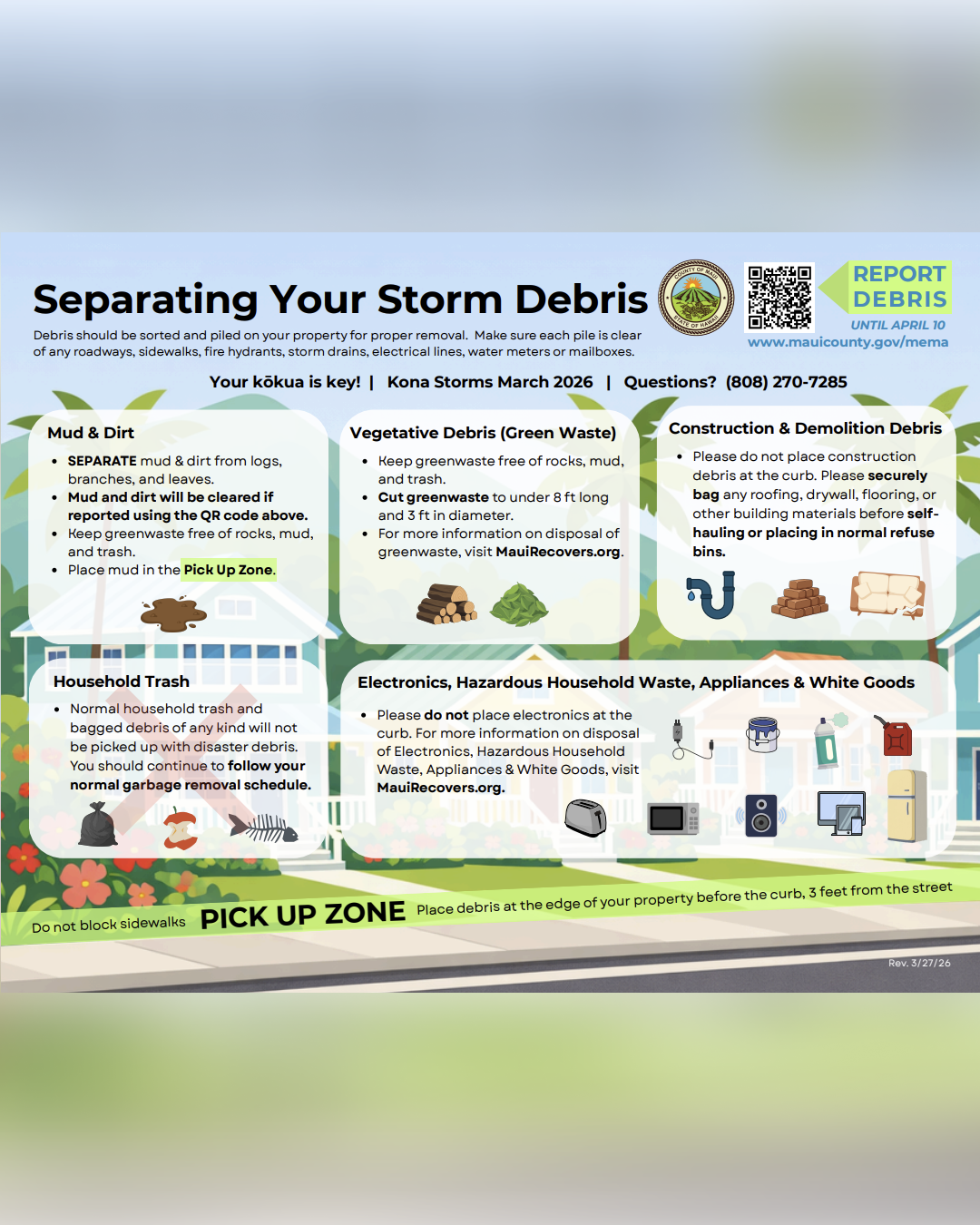
Separate & Report Your Debris

For kūpuna and those that are physically unable to self-haul debris, please notify the County by filing out an online storm debris report at mauicounty.gov/mema. Please describe the types and amount of debris.

For those needing assistance with the online form, please call MEMA at (808) 270-7285.

The County is working to organize curbside pickup for residents unable to self-haul their debris. In preparation for this, please separate and pile your debris into the below types:

  • Greenwaste (Vegetative): Make sure greenwaste is free of rocks, mud, or any trash. Please cut greenwaste to less than 8ft in length and 3ft in diameter.
  • Construction and Demolition (C&D): Please securely bag any roofing, drywall, flooring, or other building materials before placing in normal refuse bins.

PLEASE DO NOT PLACE PILES ON ROADWAYS OR SIDEWALKS. To ensure safe access for collection crews and emergency vehicles, piles must be kept away from:

  • Fire Hydrants
  • Mailboxes
  • Utility poles
  • Storm drains

Self-Haul Debris

The County encourages self-hauling when possible, to reduce the strain on local resources. Below are options for residents capable of hauling their own debris:

  • Green Waste: Residents may transport green waste directly to the following locations:
    • Maui EKO Systems, Central Maui Landfill, 1 Pulehu Rd, Puunene, 96784
    • Hawaii Organics Compost, Kuihelani Hwy, Wailuku, 96793
    • Green Waste Containers: Community groups or residents with large amounts of green waste and accessible property may be eligible for a 30-yard roll-off container. Availability is first-come, first-served while funds last. To request a container, call the Environmental Protection and Sustainability Division at (808) 270-7631.
  • Appliances (Self-Haul): Residents may self-haul appliances to:
    • Hammerhead Metals Recycling, 2000 Maui Veterans Hwy, Puunene, 96784
  • Construction and Demolition Debris (C&D): Residents may self-haul residential building materials to a County landfill or convenience center.

Lithium-ion Batttery Disposal

Lithium-ion batteries can be found in electric and hybrid vehicles, e-bikes, e-scooters, electric lawn mowers, and backup storage systems for solar panels. When flooded they should be removed from your home or garage in case of fires. Damaged batteries may feel hot, emit smoke, or make unusual noises but will not always show these signs. Flooded electric or hybrid vehicles should be pushed or towed and not turned on. They should be checked by a mechanic when possible before driving. Smaller flooded lithium batteries should not be placed in regular trash or recycling as they can cause fires in transportation or at landfills and recyclers. Visit EPA’s waste battery pages to determine what kind of battery you have and to find options for safe recycling or disposal. Use the National Fire Protection Association’s Flooded Electric or Hybrid Vehicle Bulletin for more information on your battery powered vehicle.

Debris Cleanup Resources

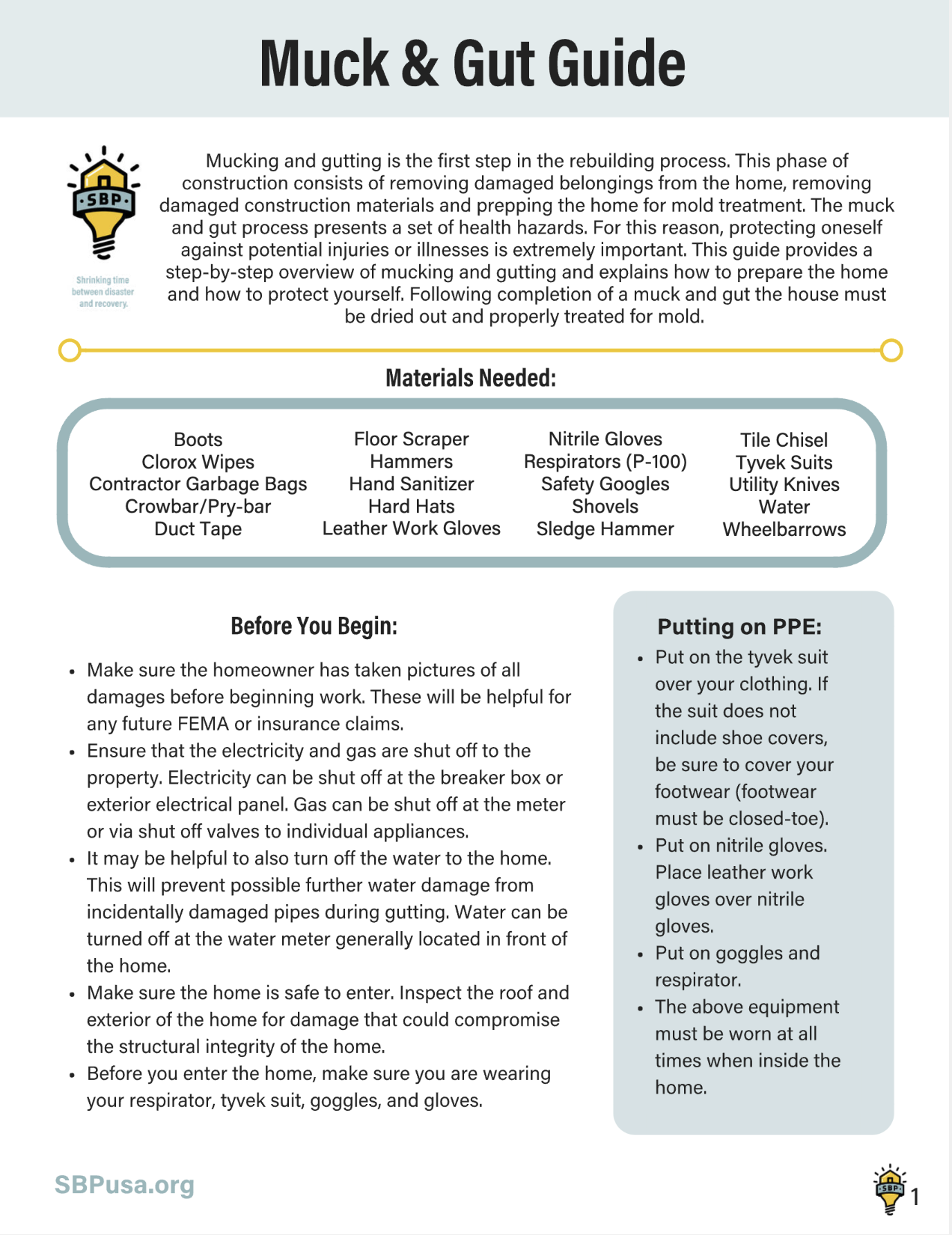
Muck & Gut and Health Guidance (PDF)

Mucking and gutting is an important first step after flooding. This process includes removing damaged belongings and materials and preparing the home for mold treatment and repair.

Request Red Lightning Assistance with Debris Cleanup

Red Lightning is mobilizing to assist with cleanup and recovery efforts, helping residents clear debris and begin rebuilding.

Health Safety for Post-Flood Cleanup

The Hawai‘i Department of Health (DOH) is urging residents impacted by recent flooding across the state to take precautions during cleanup and recovery efforts to protect their health and safety.

Floodwater contains hazards. Properly cleaning and drying your home after a flood can make it safe to re-occupy.

As communities begin cleanup and recovery, DOH is providing the following guidance:

Floodwater Safety

  • Floodwater contains hazards. Avoid entering or playing in floodwater whenever possible.

If you come into contact with floodwater:

  • Wash exposed skin with soap and clean water as soon as possible.
  • Use alcohol-based wipes or sanitizer if clean water is unavailable.
  • Clean and cover any wounds and seek medical care if needed.
  • Wash contaminated clothing in hot water with detergent before reuse.

More info - Flooding


Safe Cleanup Procedures

  • Get the mess out. Remove all floodwater, dirt and debris left behind by the floodwater as soon as possible.
  • Remove mold and mildew. Moldy or mildewed building materials should be thoroughly cleaned and dried or removed and replaced. Any materials or furnishings that soaked up water and cannot be cleaned thoroughly should be removed from the building.
  • Check your flooring. Carpet and padding cannot typically be cleaned well enough. Throw them away.
  • Dry out walls. Walls must remain open to allow them to completely dry. Plaster, brick and concrete block walls can probably be cleaned, disinfected and completely dried.
  • Salvage what you can. Personal property and furnishings that are wet for 24-48 hours after floodwater recedes, will most likely have mold growing in or on them. Clothing and linens may be salvaged by washing with detergent.
  • Discard porous materials that cannot be laundered and disinfected.
  • Do not re-enter flooded buildings until electricity is shut off, gas lines are secured and the structure is deemed safe.
  • Avoid direct contact with contaminated materials and damp vegetation.
  • Do not eat, drink, or smoke in contaminated areas; wash hands frequently.
  • Do not mix cleaning products together or add bleach to other chemicals. Mixing cleaning products can create toxic vapors. Follow the directions on the label.
  • Ensure your tetanus vaccinations are up to date.


Mud Cleanup FAQ

Is the mud/sediment around/in my home safe?

  • We know that flooding is a hazard and can make your house unsafe. That’s why we are providing guidance for cleaning up to restore your home. The cleanup guidance is based on national standards for flood-impacted communities. Following this guidance helps mitigate common flood hazards, including things like flood-carried mud and sediment. 
  • We also encourage homeowners to dry out their belongings and mud outside in the sun. Sunlight helps kill microbes.

Will DOH test the mud/sediment?

  • Yes, as the Governor announced, mud will be tested, in coordination with partner organizations. However, you don’t need to wait to clean up your home. Follow the recommended methods and guidance to safely clean up.


Mold Cleanup and Prevention

Mold growth can begin quickly after flooding and may pose health risks.

  • Any indoor mold should be addressed promptly.
  • Before cleaning, lightly spray moldy surfaces with a soapy solution to reduce airborne particles.
  • Clean with soap and water, then disinfect using a bleach solution (1 cup bleach to 1 gallon of water). Open windows and doors first. Never mix bleach with other cleaning products containing ammonia. Use as directed on label.
  • Allow at least 15 minutes of contact time, then rinse and dry thoroughly.
  • Promote airflow to speed drying and prevent regrowth.

Discard materials that cannot be safely cleaned:

  • Carpets, mattresses, upholstery and other porous items wet for more than 24–48 hours
  • Items that cannot be laundered or disinfected

Clothing and linens may be salvaged by washing with detergent and bleach.


Recommended Personal Protective Equipment (PPE)

When cleaning or entering affected areas, wear:

  • Waterproof boots (steel toe/shank recommended)
  • Rubber or heavy-duty gloves
  • NIOSH-approved N95 mask
  • Sealed safety goggles
  • Long sleeves, long pants, or protective coveralls
  • Hard hats where debris hazards exist


Power Outage and Food Safety

Food may not be safe after a power outage — even if it looks or smells normal.

  • Refrigerated food lasts less than four hours without power.
  • Frozen food lasts:
    • Up to 24 hours in a half-full freezer
    • Up to 48 hours in a full freezer (if unopened)

Food safety tips:

  • Never taste food to determine if it is safe.
  • Throw away perishable foods after four hours without refrigeration.
  • Discard any food with unusual odor, color, or texture.
  • Discard food that has come into contact with floodwater.
  • Food above 40°F should be thrown out.
  • Frozen food with ice crystals or at 40°F or below may be safely refrozen or cooked.

When in doubt, throw it out.


Disease Risks and Prevention

Leptospirosis

  • Caused by bacteria found in water contaminated with animal urine (especially rats).
  • Enters the body through cuts or mucous membranes.
  • Early symptoms: fever, chills, muscle aches.


Prevention:

  • Avoid contact with floodwater, mud and damp materials.
  • Cover cuts and wear protective clothing.
  • Keep contaminated water out of catchment systems.


Seek medical care promptly if symptoms develop. Early treatment is critical.

More info - Leptospirosis


Rat Lungworm Disease

  • Caused by a parasite carried by rats, slugs and snails.
  • Risk increases after heavy rains.


Prevention:

  • Wash all produce thoroughly, even if labeled “pre-washed.”
  • Inspect leafy greens for slugs or snails.
  • Wash hands after gardening or handling produce.
  • Control pests by removing food sources, securing trash and eliminating standing water.

Seek medical attention if symptoms such as severe headaches, stiff neck, or neurological issues develop.


Mosquito Control

Standing water after flooding can increase mosquito populations.

  • Drain standing water from containers, tarps, gutters and catchment systems.
  • Cover water storage containers.
  • Use EPA-approved insect repellent and wear protective clothing.
  • Repair window and door screens.

Mosquitoes in Hawai‘i can carry diseases such as dengue, chikungunya and Zika. While these diseases are not currently present in Hawaiʻi, controlling mosquitoes is the best way to prevent them from occurring.

More info – Mosquito Control


When to Seek Medical Care


Seek medical attention if you experience:

  • Signs of wound infection (redness, swelling, drainage, fever)
  • Persistent cough, wheezing, or breathing difficulty
  • Vomiting, diarrhea, or stomach pain after exposure
  • Fever, headache, rash, or joint pain after mosquito bites or floodwater exposure


A tetanus booster may be recommended for contaminated wounds.


Caring for Mental Health After a Disaster


Recovering from a disaster can take a toll on emotional well-being.


For individuals and families:

  • Stay connected with family, friends and neighbors
  • Limit repeated exposure to disaster-related media
  • Maintain routines, rest and proper nutrition
  • Practice healthy coping strategies

DOH Resources – Adult Mental Health Division


Supporting keiki:

  • Reassure children they are safe
  • Keep routines consistent
  • Encourage open conversations about their feelings
  • Limit exposure to distressing news
  • Seek professional help if distress continues

DOH Resources – Child & Adolescent Mental Health Division


Support is available through the Hawaiʻi CARES crisis line. Call, text, or chat 988.


Additional Safety Reminder

Flood-damaged homes may not be safe to occupy until they are fully cleaned, disinfected and dried. Consult professionals when in doubt.

DOH encourages residents to take these precautions seriously to prevent illness and injury during recovery.

For more information, visit the Hawai‘i Department of Health website.

Latest Storm-related News

Have Questions?

The County of Maui welcomes your questions and feedback to help guide efforts in providing you and the community with the most beneficial information.

Feel free to email support@mauirecovers.com directly.

Mahalo for sharing your comments and feedback. Our team will get back to you shortly.

Oops! Something went wrong while submitting the form.